

Milk collection · compartmentalised insulated tankers
Add route optimisation to your software for milk collection.
Help your customers make full use of their tankers’ capacity, even with compartments of different volumes. API Optim assigns each type of milk to the right compartments and optimises the routes, from the first farm to unloading at the dairy.
- Global optimisation of collections and routes
- Compartment management and product downgrading
1 grade
Per compartment:
milk types are never mixed in the calculation.
Day and night
Farm schedules:
collection time windows and drivers’ night work taken into account.
650 companies
already use our route optimisation engine,
across all industries.
The challenges of milk collection
Every litre collected depends on how your customers are organised.
Collecting raw milk from dozens of farms, often at night and within the cold chain, leaves little room for improvisation. With volumes changing every day, separate milk streams and tanker capacities, a poor allocation can mean going back to a farm or sending an extra vehicle.

Volumes and times that change every day
Collected quantities vary by farm, by season and with the milking schedule, and collections often take place at night or early in the morning. Routes must follow these volumes and time windows without exceeding compartment capacities.

Milk streams that must never be mixed
Organic milk, conventional milk, PDO milk or other grades: every volume must go into a compatible compartment. Mixing can lead to downgrading and the loss of value of the milk collected from producers.

Tankers whose capacity is more than just the total
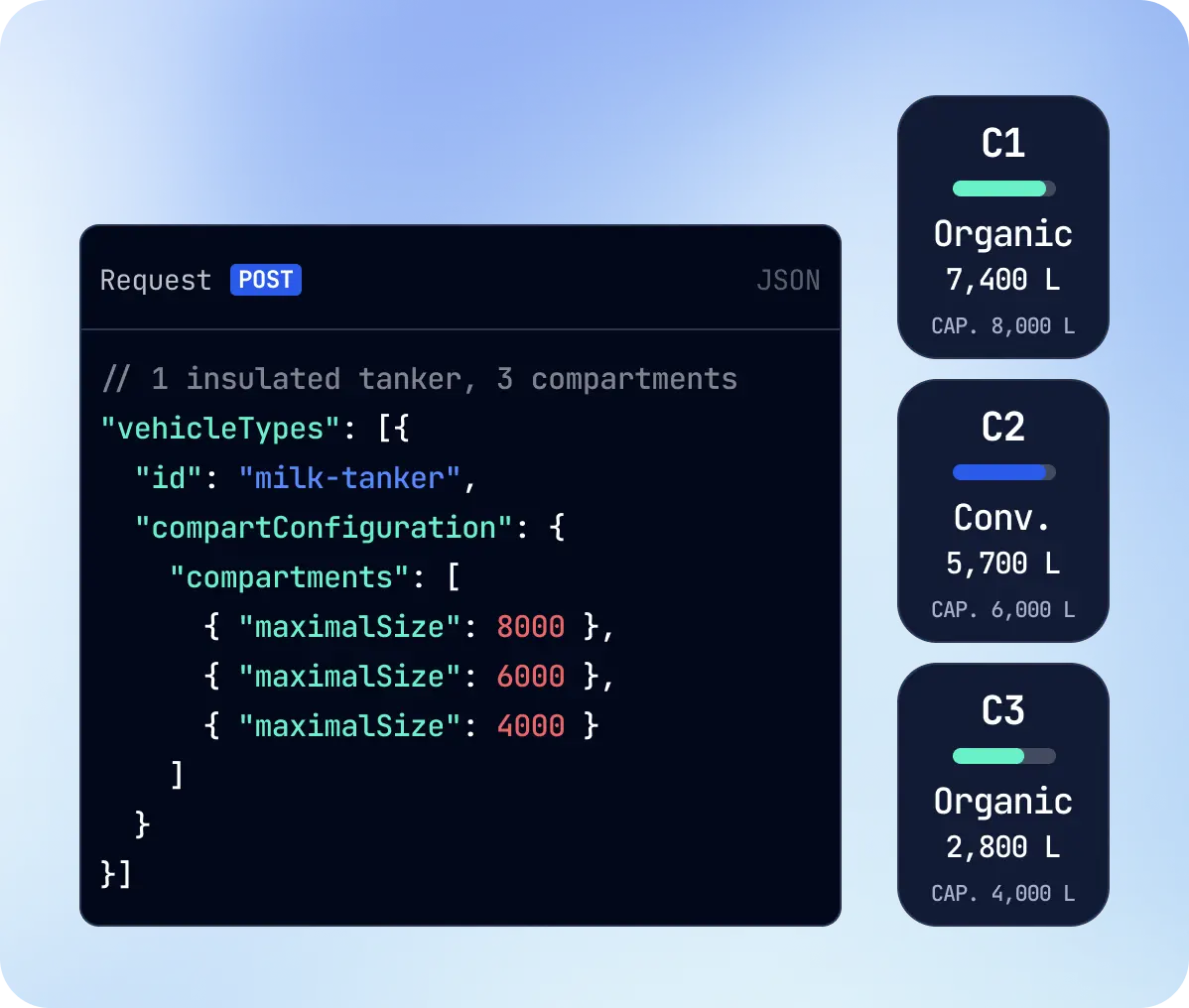
Insulated tankers have compartments of equal or unequal volumes. Enough total capacity does not guarantee that every collection can be loaded: each compartment must be able to hold the volumes assigned to it.
Why API Optim?
Your collection software, with the real tanker configuration.
Does your collection software take into account the real configuration of your customers’ tankers? With API Optim, the capacity of each compartment, milk grades, volumes and collection times all go into the same calculation.
| Criterion | Without compartment management | With API Optim |
|---|---|---|
| Tanker capacity | Only the vehicle’s total capacity is taken into account. | Each compartment is taken into account with its actual capacity. |
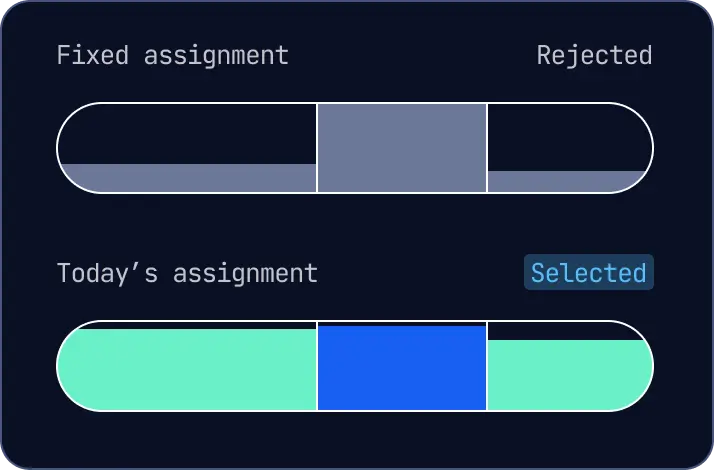
| Compartment assignment | The allocation of milk grades may stay fixed. | The assignment is recalculated according to the volumes to collect. |
| Milk separation | Load compatibility requires a separate check. | Organic / conventional separation constraints are built into the calculation. |
| Collection times | Farm time windows are managed separately. | Farm schedules, night work and driving time built into the calculation. |
| Route optimisation | Loads and routes are calculated separately. | Compartment assignments and routes are optimised together. |
Illustrative comparison with management that does not take compartments into account in detail. Features vary between software products.
Tanker optimisation
Milk collections prepared from the first farm to the dairy.
API Optim allocates milk volumes across the compartments of your customers’ tankers while optimising the order of farm visits. Their teams get a usable result to prepare collections and organise unloading at the dairy.
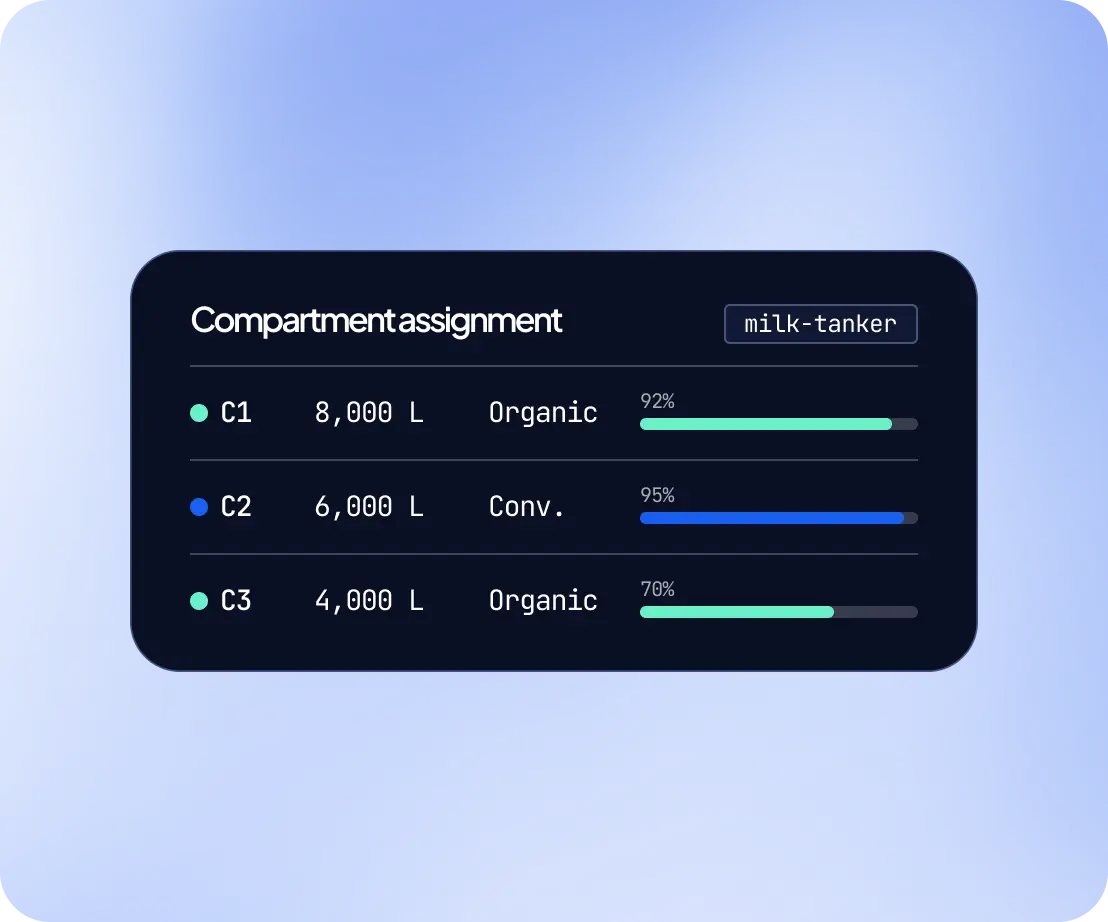
Every collection assigned to the right compartment
The engine takes into account the volumes to collect, tanker capacities and milk grade. It looks for an allocation that is compatible with the separation rules and the routes.
The information needed for collection, farm by farm
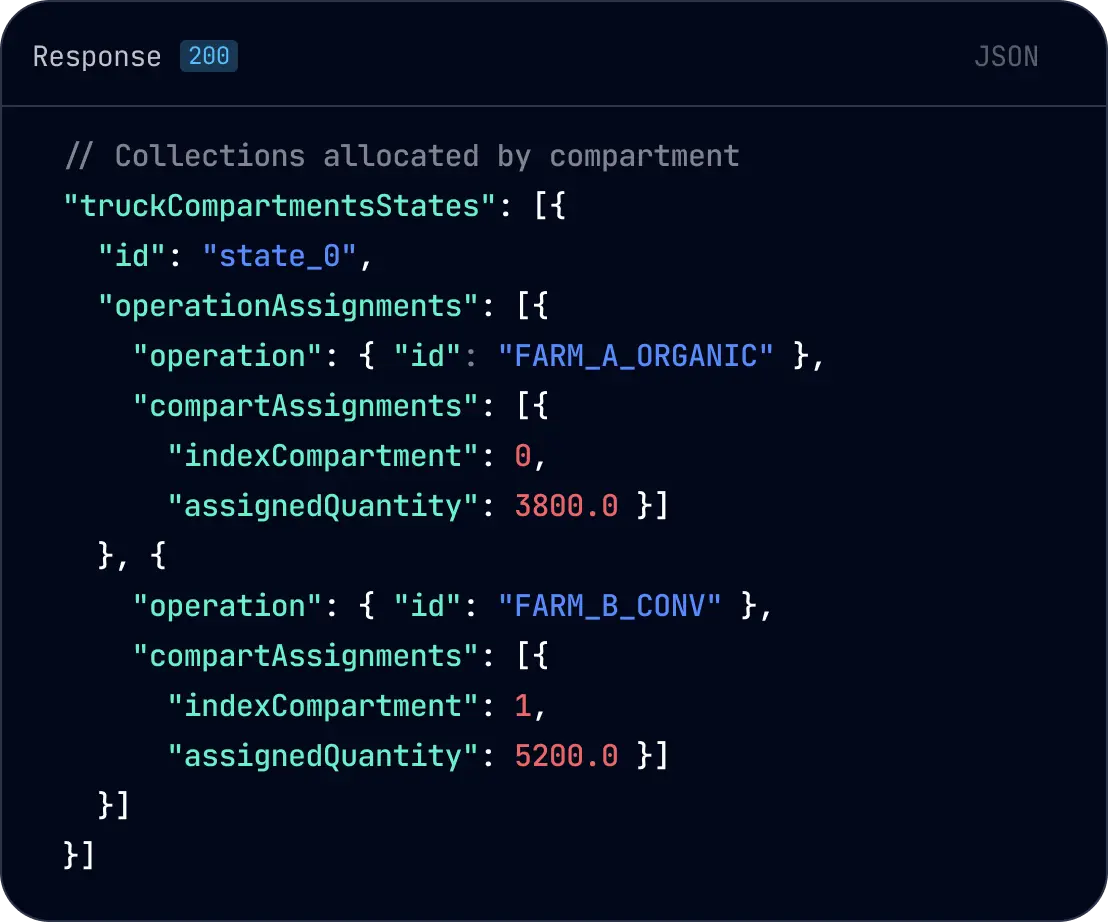
For each route, your software retrieves the farms to visit, their visiting order and the assigned compartments. Time spent at the farm (connection, pumping, sampling) is taken into account according to the volume collected, as is the number of unloading bays available at the dairy. The compartment states returned by the API follow the collection through to unloading.
Better use of a fleet of tankers and trailers
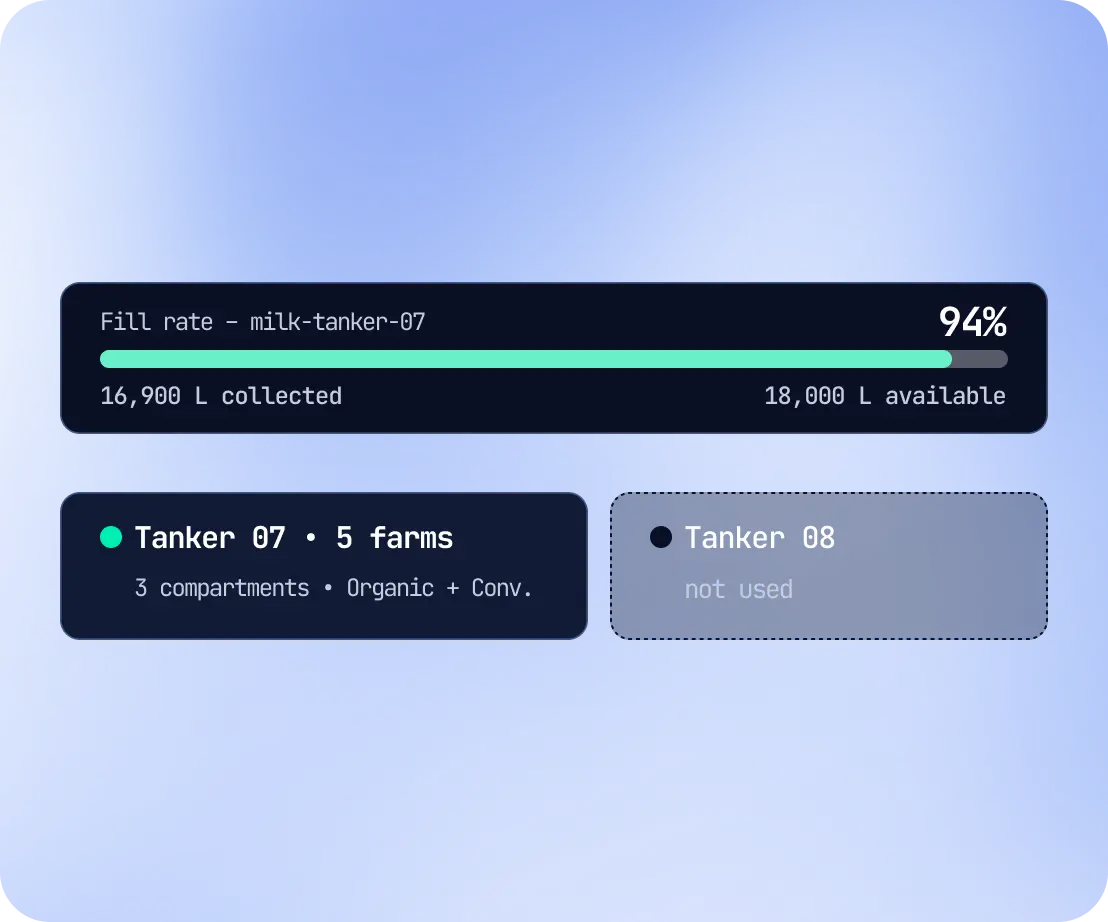
Compartment assignment adapts to the day’s volumes. A collection that exceeds a tanker’s capacity can be split across several routes, and trailers are managed: coupling, uncoupling and transferring milk from the rigid vehicle. Your customers thus reduce unused capacity and extra routes.
An API designed for your business software
Integrate collection optimisation into your software in three steps.
Your milk collection management software stays at the centre. API Optim calculates compartment assignment and routes, then returns results ready to use in your software.

Step 1
Send your customers’ tankers, collections and constraints
Your software provides the farms to visit, the volumes of milk to collect, their grade and their times. It describes the compartments of the insulated tankers, by volume, weight or quantity, using the model compartCapacityAndAccessRule.
Step 2
Let API Optim calculate the collection routes
The engine assigns volumes to compartments while respecting milk separation, farm time windows and driving times. At the same time, it optimises how farms are distributed between vehicles and their visiting order.

Step 3
Retrieve the routes and collection plans
Your software receives the routes, the visiting order and the compartment assignments. The truckCompartmentsStates data shows the state of the compartments at each stage. If a collection cannot be scheduled, the API gives the likely reasons.
What your customers gain
Lower collection costs, a better-used fleet.
Do your customers want to absorb variations in milk production without sending more lorries? By adapting compartments to the volumes collected and limiting unnecessary journeys, they gain concrete levers on the profitability of their routes.

Fewer kilometres and night hours
Assigning farms to vehicles and optimising the visiting order reduces unnecessary journeys and night working time. Your customers cut fuel and collection costs.

Milk value preserved
Separation rules between organic and conventional milk are respected from the route calculation onwards. The risk of mixing due to poor compartment assignment is reduced.

Lactation variations better absorbed
Routes adapt to the volumes sent for each farm, especially during production peaks. Better use of compartments can save your customers from sending extra vehicles.
FAQ
Your questions about milk collection route optimisation.
How can milk collection routes be optimised?
API Optim calculates routes taking into account the volumes to collect at each farm, the capacity of the tankers, collection times and milk separation rules. The engine looks for a compartment assignment and visiting order suited to your customers’ constraints.
Can organic and conventional milk be collected in the same tanker?
Yes, in separate compartments. An incompatibility rule prevents the two grades from sharing a compartment. It can also separate them at vehicle level, if your customer prefers dedicated routes for each stream.
How do you manage tankers with compartments of different volumes?
Your software describes each compartment with its actual capacity. API Optim uses it to determine the volumes that can be assigned to it. Capacities are expressed in the unit of your choice for each calculation: volume, weight or quantity.
Does the API take night collections into account?
Yes. Your software sends each farm’s collection times, and drivers’ night work and driving time rules are built into the route calculation.
How can routes be adapted to collection volumes and frequencies?
For each calculation, send the farms to collect from and their expected volumes. Your business software selects the farms to visit according to their collection frequency, for example every two or three days. API Optim then builds the corresponding routes and compartment assignments.
Can a collection be added to a route that is already planned?
Yes. The API can insert an operation into an existing route by looking for the best position, or evaluate a route modified by a planner.
What happens if a collection cannot be scheduled?
The API flags unscheduled operations and can give their likely reasons, such as a missed time window or a farm too far from the route.
Can API Optim integrate with my milk collection software?
Yes. API Optim works alongside an existing ERP, TMS or business software. You send the data needed for the calculation and retrieve the results in your own environment.
How long does it take to integrate API Optim?
It depends on your software, your data structure and the features to integrate. Our team can review your project and support you through the integration steps.
Take the next step
Integrate the optimisation API for milk collection.
Could your customers’ tankers collect more with a different compartment allocation? Let’s talk about it, starting from your software and your customers’ routes.
Industries related to milk collection

Fuel transport
Compartmentalised tankers and bulk liquid products that must never be mixed.


Multi-temperature transport
For packaged dairy products delivered at different temperatures.

