

Fuel transport · multi-product tankers
Add route optimisation to your software for fuel deliveries.
Help your customers make full use of their tankers’ capacity, even with compartments of different volumes. API Optim allocates diesel, petrol and heating oil orders to the right compartments and optimises routes based on the volumes to deliver and the constraints of each delivery point, directly from your software.
- Global optimisation of loads and routes
- Separation of the different fuel types
- Compartments shared between deliveries, on vehicles fitted with a flow meter
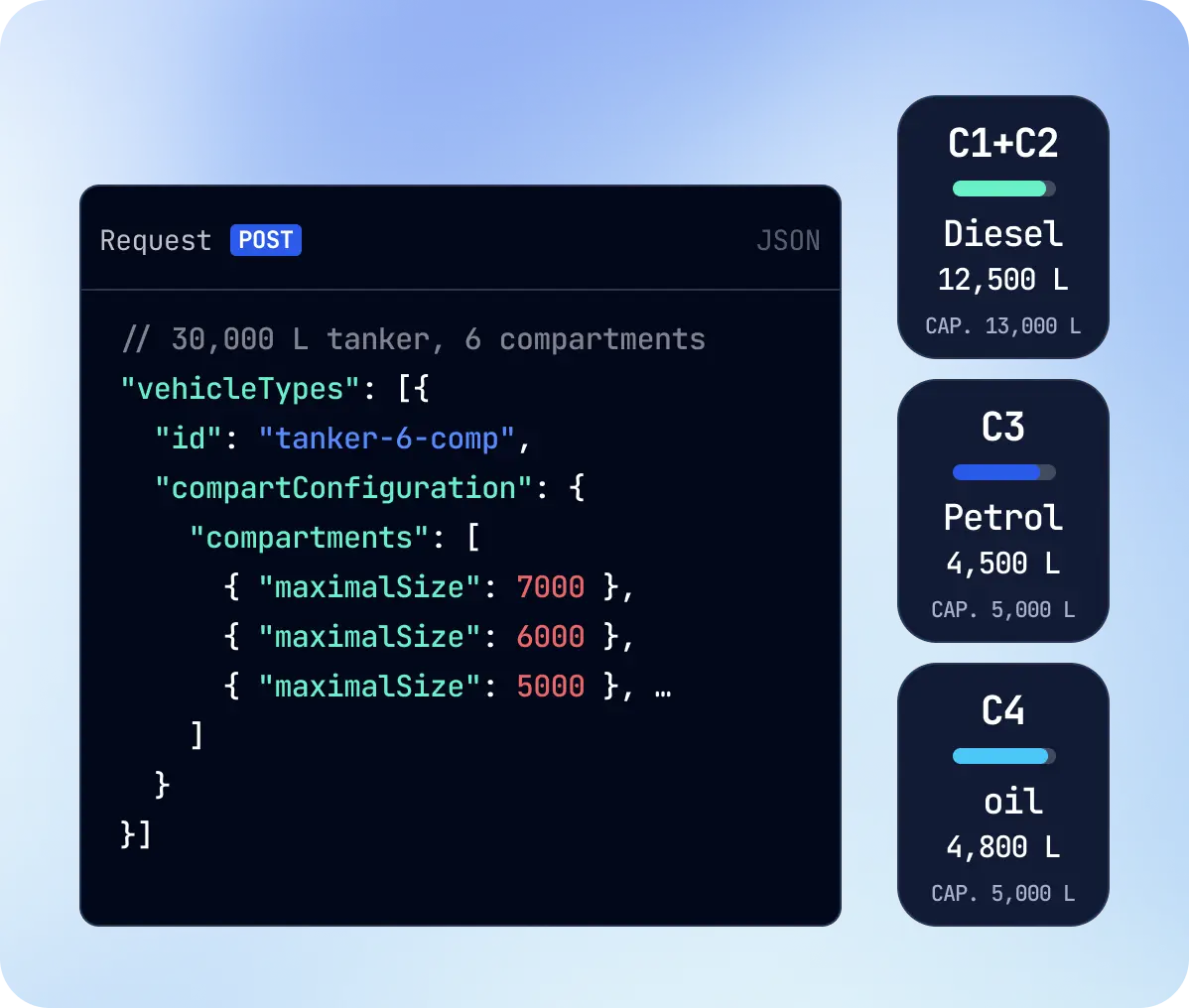
1 product
Per compartment:
several customers can be delivered from the same compartment, always with the same product.
Multiple routes
Per vehicle per day,
with reloading at the fuel depot between two routes.
650 companies
already use our route optimisation engine,
across all industries.
The challenges of fuel transport
One tanker, several products, dozens of customers.
Delivering several fuels with a single tanker takes more than calculating a route. Orders must be allocated across compartments, products kept separate and deliveries organised according to the quantities ordered. A poor allocation can leave capacity unused, force a return to the fuel depot or complicate delivery.

Orders that vary with the seasons
Service stations have steady needs, while households’ heating oil orders soar with the first cold snap. API Optim takes into account the volumes ordered and compartment capacities to find a suitable allocation for each route.

Products that never mix
Diesel, petrol and heating oil occupy separate compartments. A compartment can, however, serve several customers with the same product, and some compartments can be reserved for specific products. These rules are built into the calculation.

Delivery points with very different constraints
A service station receives large volumes within specific time windows, by gravity unloading. A household orders a few thousand litres, needs a flow meter and sometimes lives on a street that only a rigid lorry can access. The engine reconciles these constraints within a single route.
Why API Optim?
Routes that take account of every compartment.
Does your software take into account the actual configuration of your customers’ tankers? With API Optim, the capacity of each compartment, the authorised products and the delivery constraints are part of a single calculation.
| Criterion | Without compartment management | With API Optim |
|---|---|---|
| Tanker structure | Total vehicle capacity. | Capacity described compartment by compartment, equal or unequal. |
| Fuel allocation | Predefined or manually adjusted allocation. | Allocation calculated from orders. |
| Product separation | Additional check required. | Allocation rules built into the calculation. |
| Customers per compartment | A compartment is often linked to a single delivery. | A compartment can serve several customers with the same product. |
| Route building | Routes calculated independently of load details. | Loads and routes optimised together. |
Comparison with a simplified optimisation approach; features vary by software.
Optimisation tailored to every fleet
Fuel deliveries prepared from loading at the depot.
Why send a second vehicle or return to the depot when a different compartment allocation would carry the planned orders? API Optim looks for a fuel allocation suited to your customers’ tankers, while taking into account delivery points and the constraints of their business.
Orders allocated to the right compartments
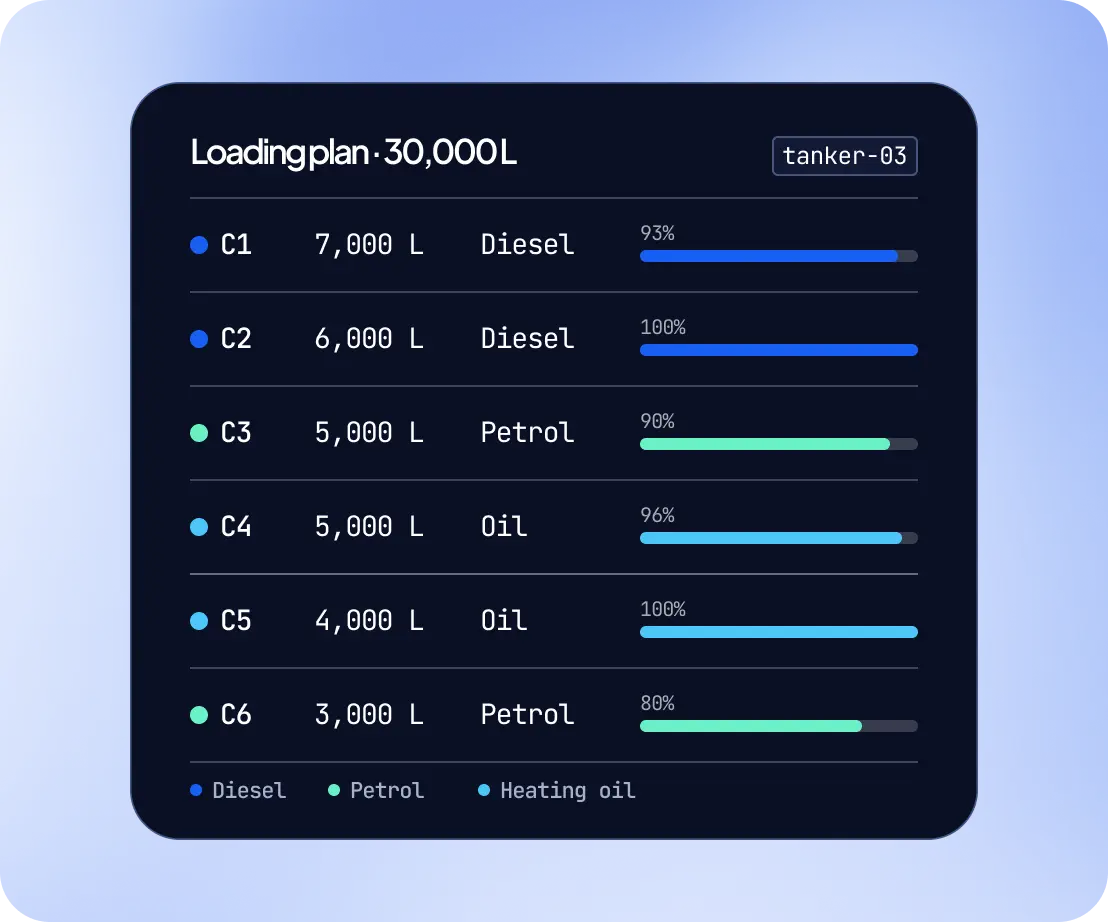
Your software describes tanker capacities, even when they are unequal, and the products authorised in each compartment. The engine looks for an allocation compatible with the available volumes. Your customers’ teams know which products and quantities to load at the fuel depot.
Loads and routes optimised in a single calculation
The choice of compartments directly affects which deliveries are possible. API Optim jointly calculates product allocation, the distribution of customers across vehicles and the stop sequence. Service stations, businesses and households have different needs: their receiving time windows, unloading time based on the volume delivered and access restrictions are all part of the calculation, for example a rigid lorry rather than an articulated lorry in a residential area.
Routes reorganised when orders change
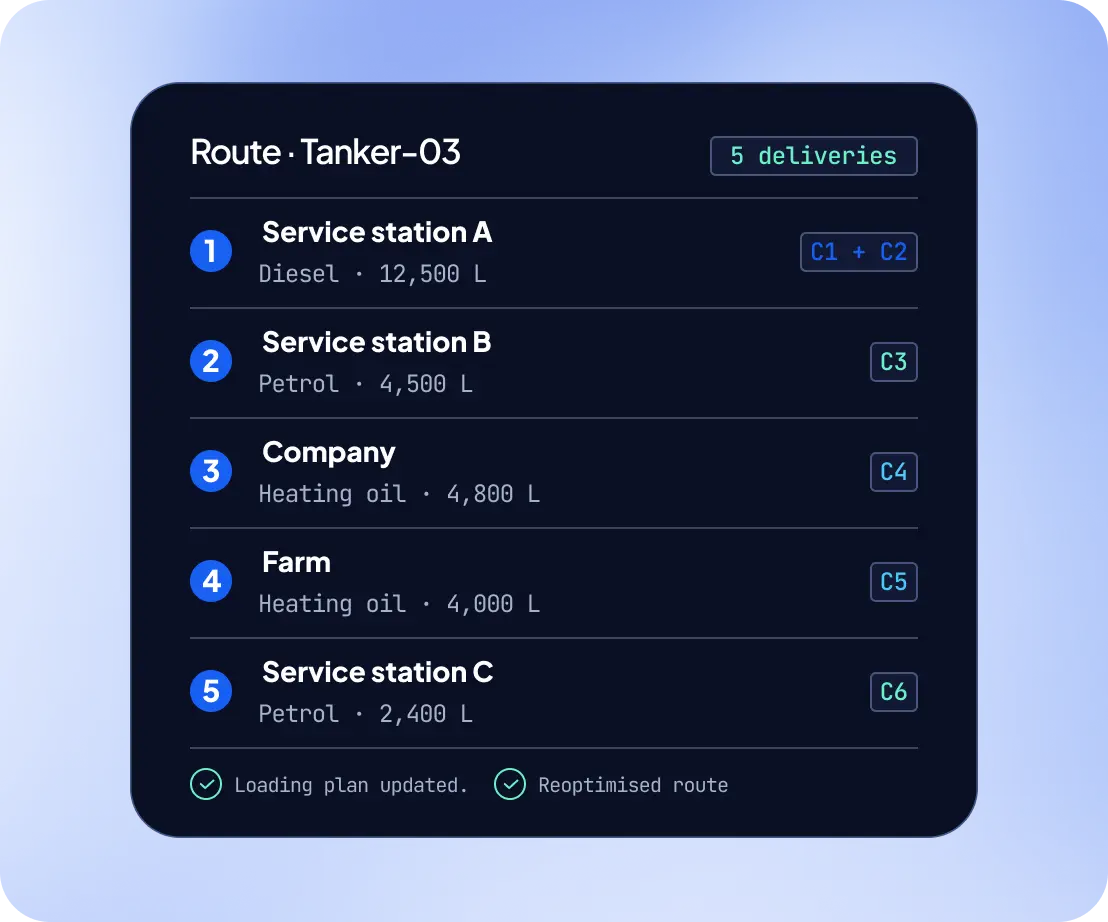
A service station orders more diesel? The first cold snap drives up heating oil orders? Your software reruns the optimisation with the new volumes. The engine looks for a new allocation, without having to keep the previous ones. A vehicle can also run several routes in a day, with reloading at the depot.

An API designed for your business software
Integrate delivery optimisation into your software in three steps.
Your fuel delivery management software stays at the centre. API Optim calculates product-to-compartment allocation and routes, then returns results ready to use in your software.
Step 1
Describe the tankers and send your customers’ orders
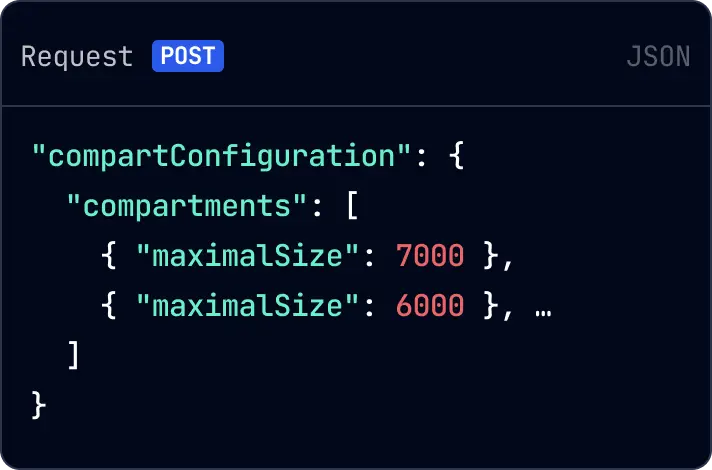
Your software sends the delivery points, the quantities of diesel, petrol and heating oil to deliver, and the receiving time windows. It describes the capacity of each compartment, in litres, using the compartCapacityAndAccessRule model, along with the products it can accept.

Step 2
Let the engine optimise loads and routes
API Optim looks for an allocation compatible with compartment capacities and fuel separation. At the same time, it calculates how customers are distributed across vehicles and the delivery sequence, taking into account time windows and driving times.
Step 3
Retrieve routes and loading plans
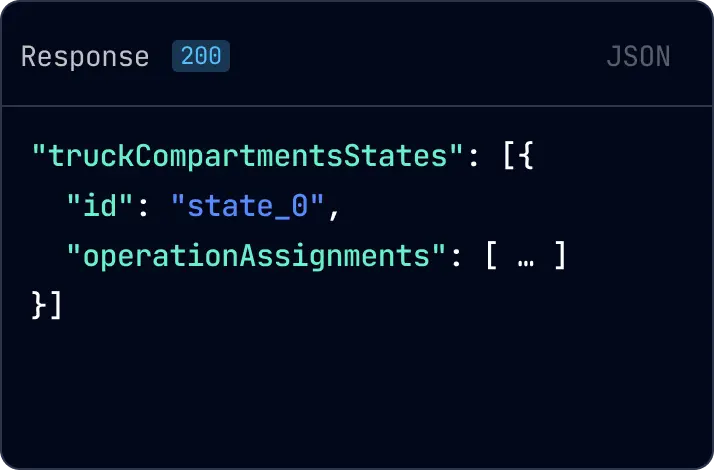
Your software receives the optimised routes, the customer sequence and, for each compartment, the product and quantity to load at the depot. The truckCompartmentsStates data show the state of the compartments at each stage of the route.
What your customers gain
Lower distribution costs, a better-used fleet.
Every unused compartment is lost transport capacity. By matching loads to orders and optimising routes, your customers cut unnecessary kilometres and make better use of their tankers.

More fuel carried with the same vehicles
Products are allocated according to the day’s orders and compartment capacities, rather than a fixed allocation. This reduces the risk of sending an extra lorry when a different allocation would have worked.

Fewer unnecessary kilometres and depot returns
Loads and the delivery sequence are optimised together to find more efficient routes. Fewer unnecessary journeys mean less fuel consumed and better-controlled transport costs.

Fuller working days
A vehicle can run several routes in a day, with reloading at the depot between two routes. Your customers deliver more without adding an extra vehicle.
FAQ
Your questions about optimising fuel deliveries.
How can diesel, petrol and heating oil delivery routes be optimised?
API Optim calculates routes taking into account orders, tanker capacities and delivery constraints. At the same time, it looks for a fuel-to-compartment allocation that keeps products separate.
Can several types of fuel be carried in the same tanker?
Yes, in separate compartments. A filling rule reserves each compartment for a single product, and your software can restrict some compartments to specific products. The same compartment can, however, serve several customers with the same product.
How are compartments of different capacities handled?
Your software describes each compartment with its actual capacity, in litres. API Optim uses this information to calculate loads suited to the configuration of each tanker, on rigid and articulated lorries alike.
Can the fuel allocation change from one route to the next?
Yes. Allocations are recalculated according to the volumes ordered. There is no need to always reserve the same compartments for diesel, petrol or heating oil, as long as the products authorised in each compartment are respected.
How are deliveries prepared from one or more fuel depots?
Each vehicle can be linked to one or more depots. For each route, the API states the quantity of each product to load per compartment. A vehicle can run several routes in a day, with reloading between two routes.
Can heating oil deliveries be restricted to rigid lorries?
Yes. Your software can restrict access to each delivery point to suitable vehicles: a rigid lorry for households in residential areas, an articulated lorry for service stations. It can also require specific equipment, such as an extra-long hose for a tank set back from the street. API Optim takes this into account to assign each delivery to the right vehicle.
How are dangerous goods transport constraints handled?
Your customers’ ADR-related operating rules become calculation constraints: products authorised in each compartment, products that must never be loaded together, deliveries reserved for equipped vehicles, drivers’ driving and rest times. API Optim builds routes consistent with their organisation. Vehicle approval, driver training and transport documents remain the responsibility of their teams.
Do my customers need to change software?
No. API Optim integrates with your software. Your software sends the data needed for the calculation and retrieves the routes and compartment allocations, while your customers keep working in the interface they know.
How long does it take to integrate API Optim into my software?
It depends on your technical environment, the data available and the functional scope to integrate. Our team can review your project to define the steps required.
Take the next step
Integrate the route optimisation API for fuel deliveries.
Could your customers’ tankers deliver more with a different compartment allocation? Let’s talk, starting from your software and your customers’ routes.
Industries related to fuel transport


