

Live animal transport · livestock trailers with adjustable decks
Add route optimisation to your software for live animal transport.
Help your customers make full use of their livestock trailers’ capacity, even with several adjustable deck configurations. API Optim optimises loads and collection and delivery routes, taking into account vehicle layout and transport constraints, directly from your software.
- Global optimisation of loads and routes
- Management of single, double and triple-deck livestock trailers
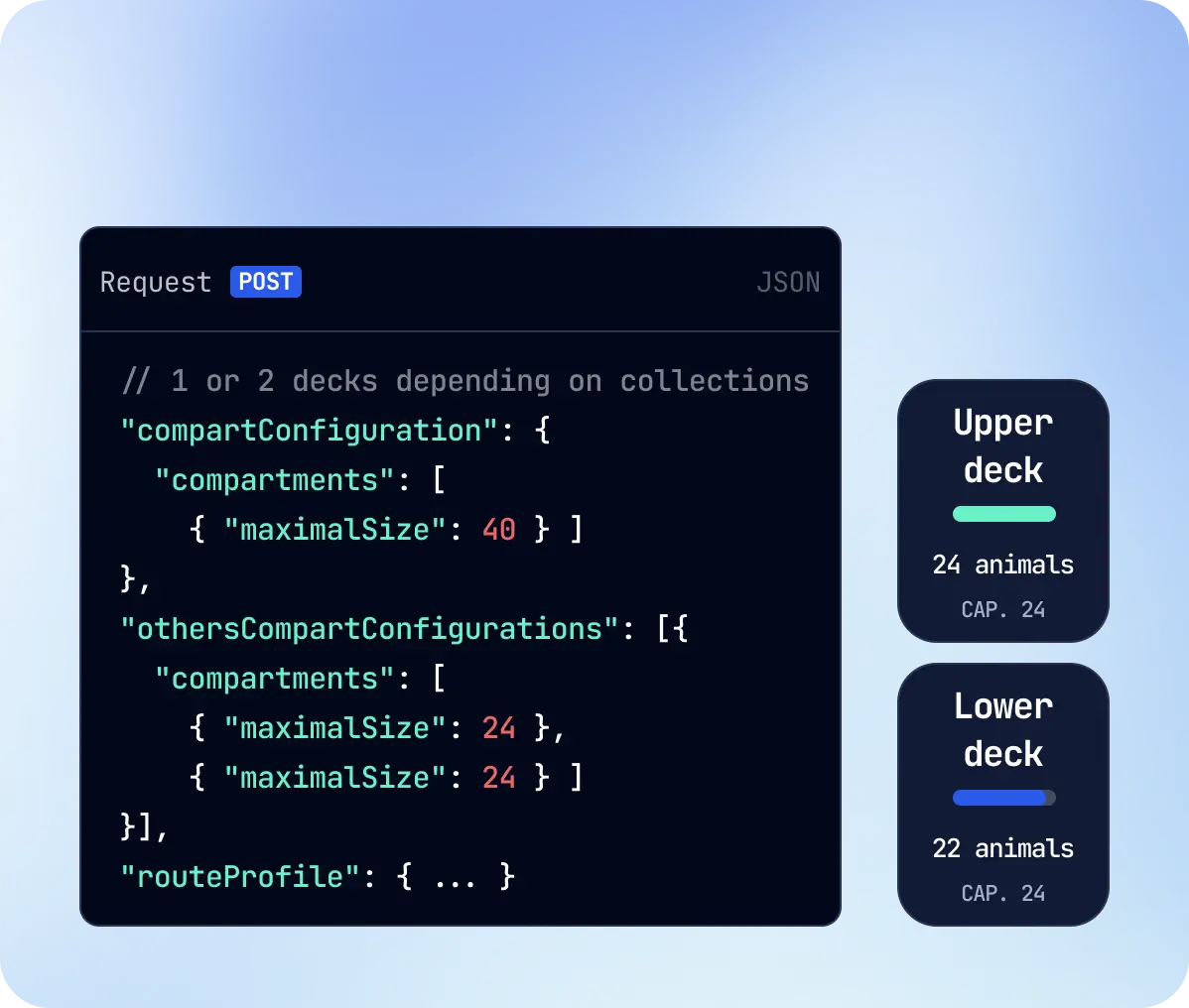
1 to 3 decks
Per livestock trailer:
every possible deck configuration is declared.
1 single calculation
To choose the layout,
allocate the animals and order the stops.
650 companies
already use our route optimisation engine,
across all industries.
The specific constraints of live animal transport
Every collection depends on the layout of the livestock trailers.
Organising a live animal collection or delivery route is not just a matter of choosing an itinerary. You also have to consider the actual capacity of the livestock trailers, their different layouts and the animals to be carried.

Livestock trailers with several possible configurations
Depending on the equipment, the same vehicle can be configured with one, two or three decks. Each layout changes the space available and the loading options.
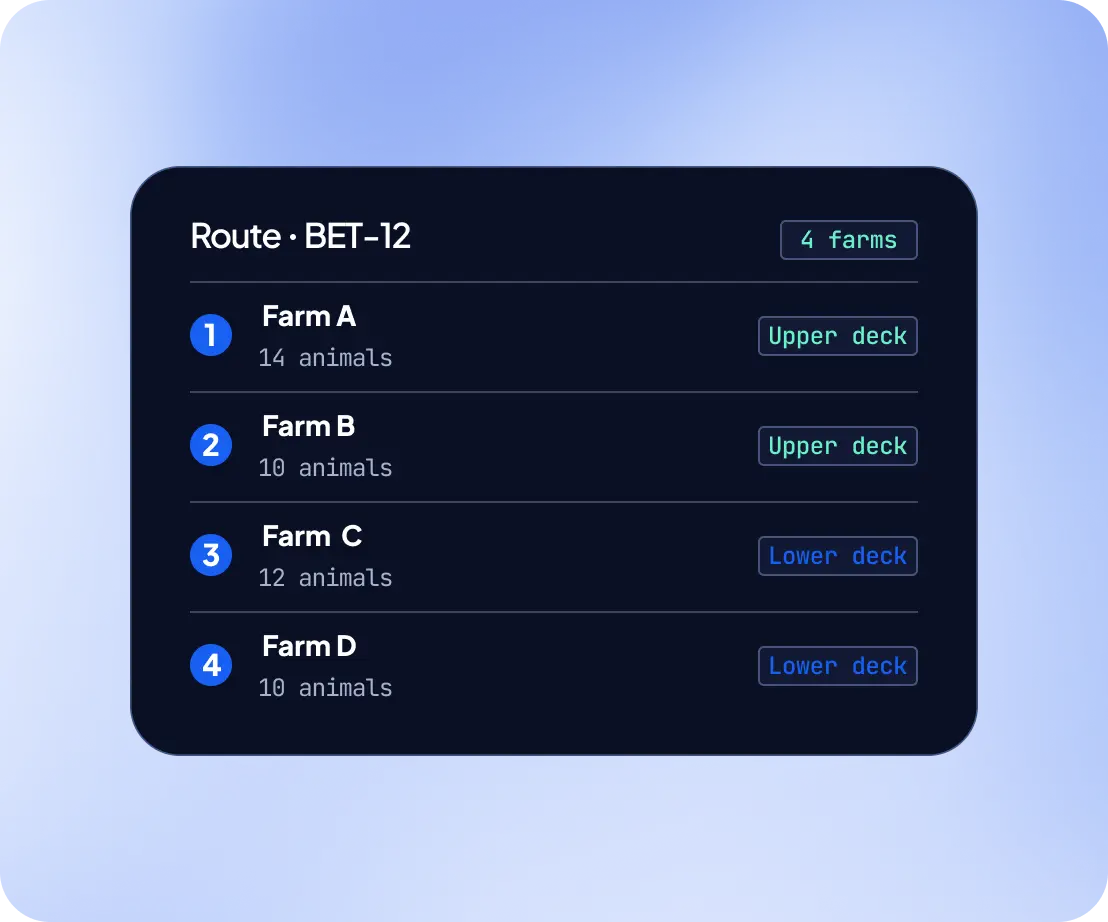
Grouping animals without adding vehicles
An unsuitable configuration can limit the number of animals carried and require an extra route, whereas another layout could allow loads to be combined.

Routes that combine collections and deliveries
Collection from farms to the abattoir or livestock assembly centre, delivery of weaned calves or piglets to fattening units: livestock trailers often do both. Delivered animals must be unloaded before the animals collected on the return journey are loaded.
Why API Optim?
Decks configured once the routes are known.
Does your software lock a livestock trailer’s configuration before knowing which animals it will carry? API Optim evaluates the possible layouts of your customers’ vehicles to find an allocation suited to the animals to be carried and the constraints of each route.
| Criterion | Planning with a fixed configuration | With API Optim |
|---|---|---|
| Vehicle configuration | Layout set before optimisation | Several layouts evaluated during the calculation. |
| Loading capacity | Capacity tied to a predefined profile. | Capacity taken into account for each configuration. |
| Adjustable decks | Position chosen in advance. | Configuration selected according to the collections. |
| Route optimisation | Routes calculated for a given layout. | Loads and routes optimised together. |
| Fleet management | Several vehicle profiles may be needed. | Several configurations declared for the same vehicle. |
Comparison with planning based on a fixed configuration. Features vary between software products.
Optimisation tailored to each type of equipment
A livestock trailer configuration suited to the animals being carried.
The right livestock trailer configuration depends on the planned collections. API Optim compares the possible deck layouts and selects the one that allows the animals to be loaded and the route to be organised.
Several layouts evaluated for the same vehicle
Your software declares the possible configurations of the livestock trailers. API Optim compares the capacity offered by each layout and selects the one that suits the planned collections, without multiplying virtual vehicles in your software.
Loads and routes optimised in a single calculation
The engine looks for the right combination of vehicle configuration, animal allocation and collection order. It follows your customers’ loading rules: batches that must not be mixed in the same compartment, decks reserved for certain categories, farm schedules and abattoir reception slots.
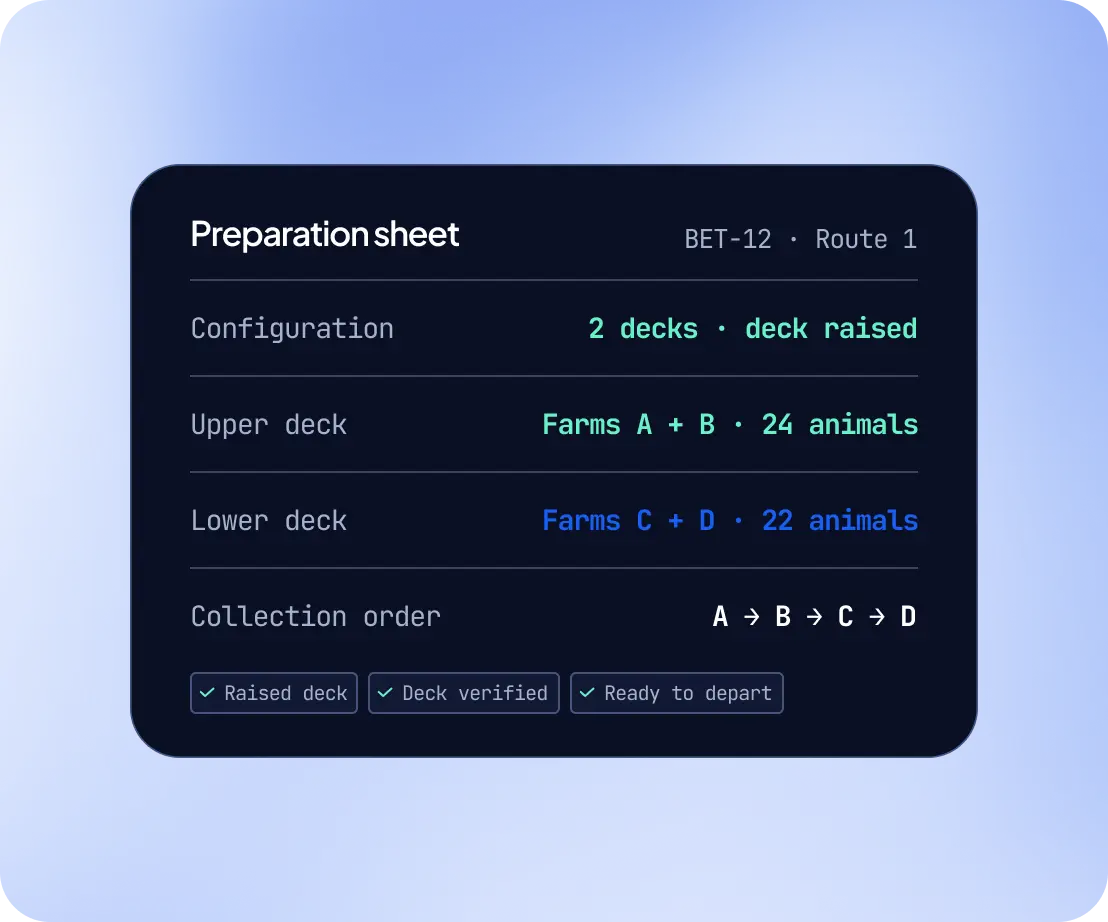
Livestock trailers prepared before departure
Your customers’ teams know which configuration to set up for each route. They can prepare the decks and organise the transport space accordingly.

An API designed for your business software
Integrate livestock trailer route optimisation into your software in three steps.
Your livestock transport management software stays at the centre. API Optim chooses the configuration of each livestock trailer, allocates the animals and orders the collections, then returns results ready to use in your software.
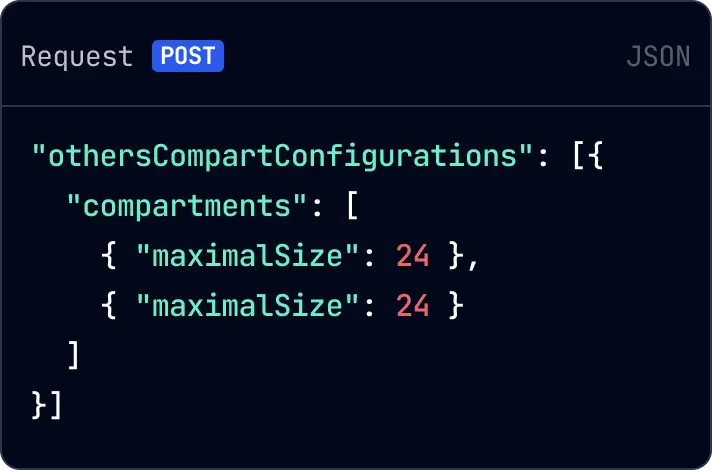
Step 1
Describe your customers’ livestock trailers and their layouts
Your software sends the characteristics of the livestock trailers, their capacities and the different possible deck configurations. The same vehicle can be linked to several layouts using the model compartMultiConfigurations.
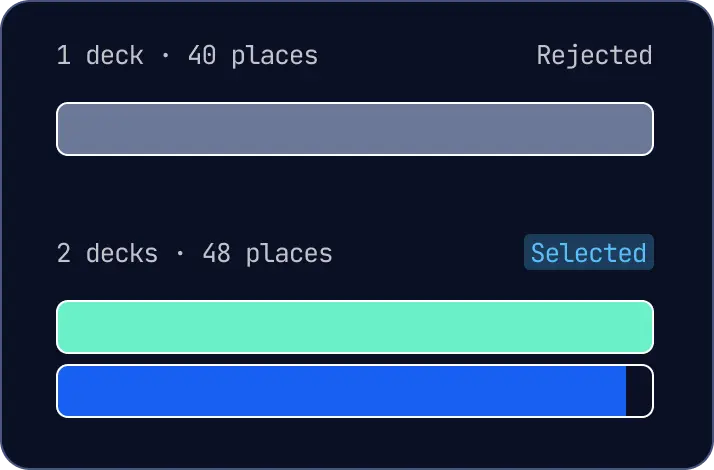
Step 2
Let the API compare the loading options
API Optim evaluates the declared configurations, taking into account the animals to collect or deliver, the capacity of each deck, farm schedules, abattoir slots and driving times. The engine looks for a solution that suits all the routes.

Step 3
Retrieve the routes and loads
Your software receives the optimised routes and, for each stage, the allocation of animals by deck via truckCompartmentsStates. The compartment size returned shows the selected layout.
What your customers gain
Better-used livestock trailers before adding vehicles.
For your customers, every unused deck is lost capacity. By choosing the right layout and combining collections and deliveries, they reduce extra routes and empty running.

Fewer extra routes
Better use of the available decks can group more collections on the same vehicle and reduce journeys, where capacity and transport constraints allow.
Combined deliveries and collections
A single route combines the delivery of livestock and the collection of animals bound for the abattoir. Empty return journeys decrease when the distribution of farms allows.

A fleet that adapts to changes in activity
During seasonal peaks, your software reruns the optimisation with updated collections and capacities. The engine re-evaluates the available configurations to build new routes.
FAQ
Your questions about live animal transport optimisation.
How can live animal collection routes be optimised?
API Optim takes into account the planned collections, the capacity of the livestock trailers, their loading configurations and the transport constraints provided. The engine looks for an allocation of loads and routes suited to your customers’ fleet.
Can livestock trailers with adjustable decks be optimised?
Yes. For each livestock trailer, your software declares the permitted configurations, with one, two or three decks, and their capacities. API Optim compares these layouts during optimisation and selects the one that suits the animals to be carried.
Can a livestock trailer deliver and then collect animals on the same route?
Yes. Your software can specify that a vehicle only accepts new collections once the delivered animals have been unloaded. API Optim then organises the route in that order.
Can different categories of animals be taken into account?
Yes. Your software sets the capacity of each deck according to the animals carried, can reserve a deck for certain categories and prevent incompatible batches from sharing the same compartment. The engine follows these rules when allocating animals.
How are animal transport rules built in?
Your customers’ operating rules become calculation constraints: number of animals per deck, batch separation, drivers’ driving time and breaks, farm schedules. API Optim builds routes that are consistent with their organisation. Regulatory and animal health checks remain the responsibility of their teams.
Can abattoir reception slots be taken into account?
Yes. A site’s access times can vary according to the species carried. API Optim takes them into account to organise the collection order and arrival at the abattoir.
Can API Optim reduce empty running for livestock trailers?
By choosing the right layout and grouping more collections on the same vehicle, your customers reduce extra routes and empty running. Gains depend on their fleet and the geographical spread of the farms.
Do my customers have to change software?
No. API Optim integrates with your software. Your software sends the data needed for the calculation and retrieves the results, and your customers keep working in the interface they know.
How long does it take to integrate API Optim into my software?
It depends on your technical environment, the data available and the features to integrate. Our team can review your project and support you through the integration steps.
Take the next step
Integrate the optimisation API for live animal transport.
Could your customers’ livestock trailers carry more animals per route? Let’s talk about it, starting from your software and your customers’ routes.
Industries related to live animal transport

Multi-temperature transport
Movable bulkheads, variable-size zones and rear access.


