

Animal nutrition · bulk and bagged delivery
Add route optimisation to your software for animal feed deliveries.
Let your customers make full use of their bulk tankers and delivery lorries. API Optim allocates feed formulas across compartments, takes into account the unloading equipment each silo requires and optimises the delivery sequence, directly from your software.
- Global optimisation of loads and routes
- One formula per compartment, delivered with the right equipment for the silo
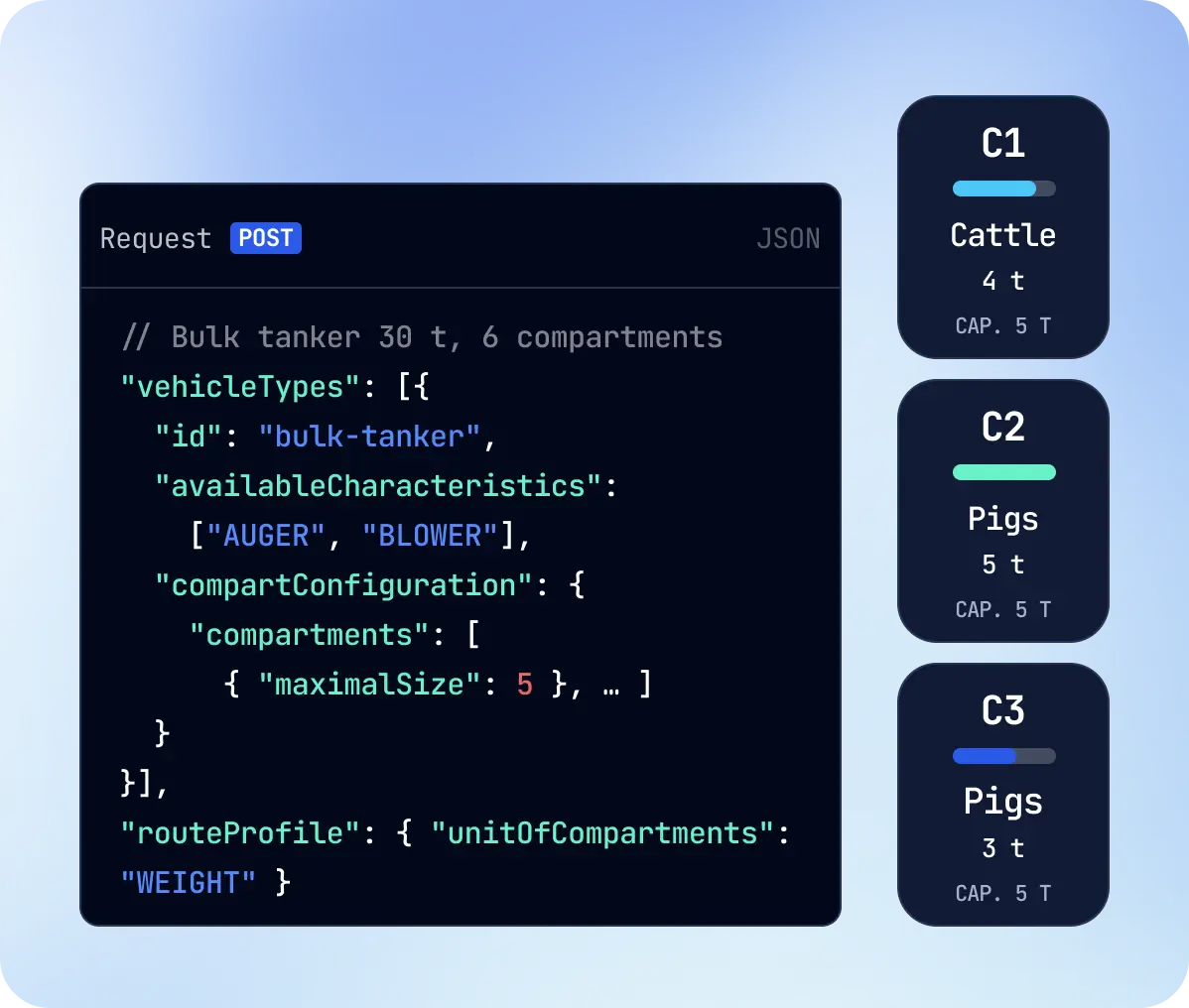
1 formula
Per compartment:
feeds don’t mix in transit.
Auger or blower
Every farm gets a lorry
equipped to unload into its silos.
650 companies
already use our route optimisation engine,
across all industries.
The constraints of feed delivery
Every farm has its own silos, access conditions and formulas.
From the feed mill to cattle, pig, poultry, sheep and goat farms, every route combines several formulas (complete, complementary or medicated feeds), an unloading method for each silo and access conditions specific to each farm. A poor allocation can leave a compartment empty, force a second trip or send a lorry that cannot unload.

Formulas to allocate across compartments
Complete or complementary feeds, cereals, oilseed meals: each formula takes its own compartment, and a single farm often orders several. The lorry’s total capacity is not enough: you need to know how many formulas it can carry, and in what quantities.

Unloading equipment suited to each silo
Depending on the farm, pellets, meal or crumbs are delivered by auger or by blower, in bulk, in bags, in big bags or on pallets. Sending a lorry that isn’t equipped for the farm’s silo means a failed delivery and a route to redo.
Farms with restricted access
Weight-restricted tracks, narrow yards, biosecurity and disinfection protocols at farm entrances, delivery time windows that vary by product: farm access determines the choice of vehicle as much as the route.
Why API Optim?
The right feed, in the right compartment, delivered by the right lorry.
Does your software know which lorry can deliver to which farm, and with which formulas? API Optim builds compartments, equipment and access constraints into route calculation.
| Criterion | Without compartment management | With API Optim |
|---|---|---|
| Lorry capacity | Total vehicle tonnage. | Capacity described compartment by compartment. |
| Formula allocation | Manual or fixed allocation. | One formula per compartment, allocation calculated from orders. |
| Unloading equipment | Checked separately, case by case. | Auger, blower, tail lift or truck-mounted forklift taken into account for each farm. |
| Farm access | Known to drivers, rarely modelled. | Size, weight and equipment restrictions built into the calculation. |
| Route building | Routes calculated independently of loading. | Loads and routes optimised together. |
Comparison with simplified planning based on overall capacity. Features vary by software.
From mill to farm
More farms served with every bulk tanker.
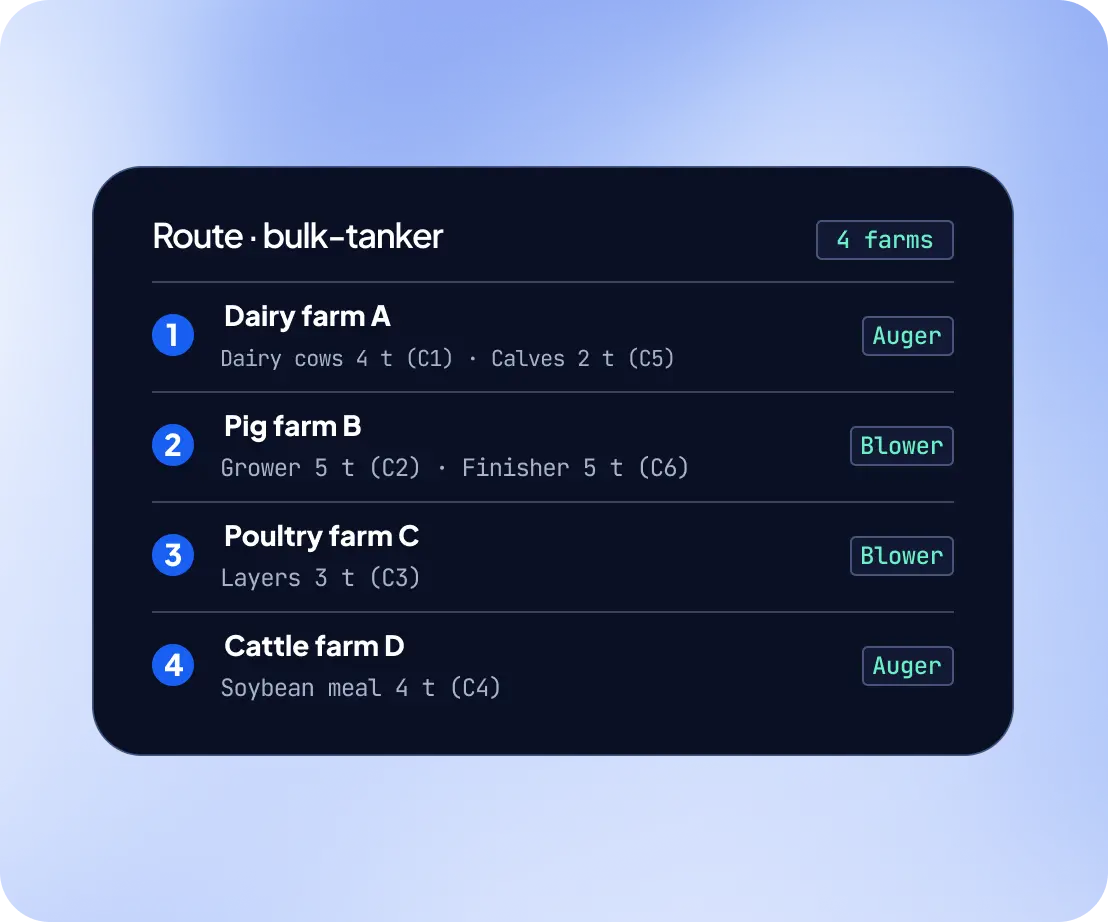
The right load depends on the day’s orders and the farms to be served. API Optim allocates feeds across compartments and assigns each farm to a vehicle equipped to unload into its silos.
Formulas allocated to the right compartments
Your software describes the compartments of compartmentalised tankers and tipper bodies, with their capacity. The engine assigns one feed per compartment and can split a large order across several compartments, to deliver several products to one or more farms on the same route, without mixing feeds.
The right lorry sent to the right farm
Bulk tankers with auger or blower, walking-floor semi-trailers, curtainsiders with truck-mounted forklift, vans with electric pallet truck: your software declares the equipment of each vehicle and the equipment each farm requires. API Optim only assigns a delivery to a vehicle equipped to unload on site, and takes into account the unloading time specific to each type of equipment.
Difficult access and large orders anticipated
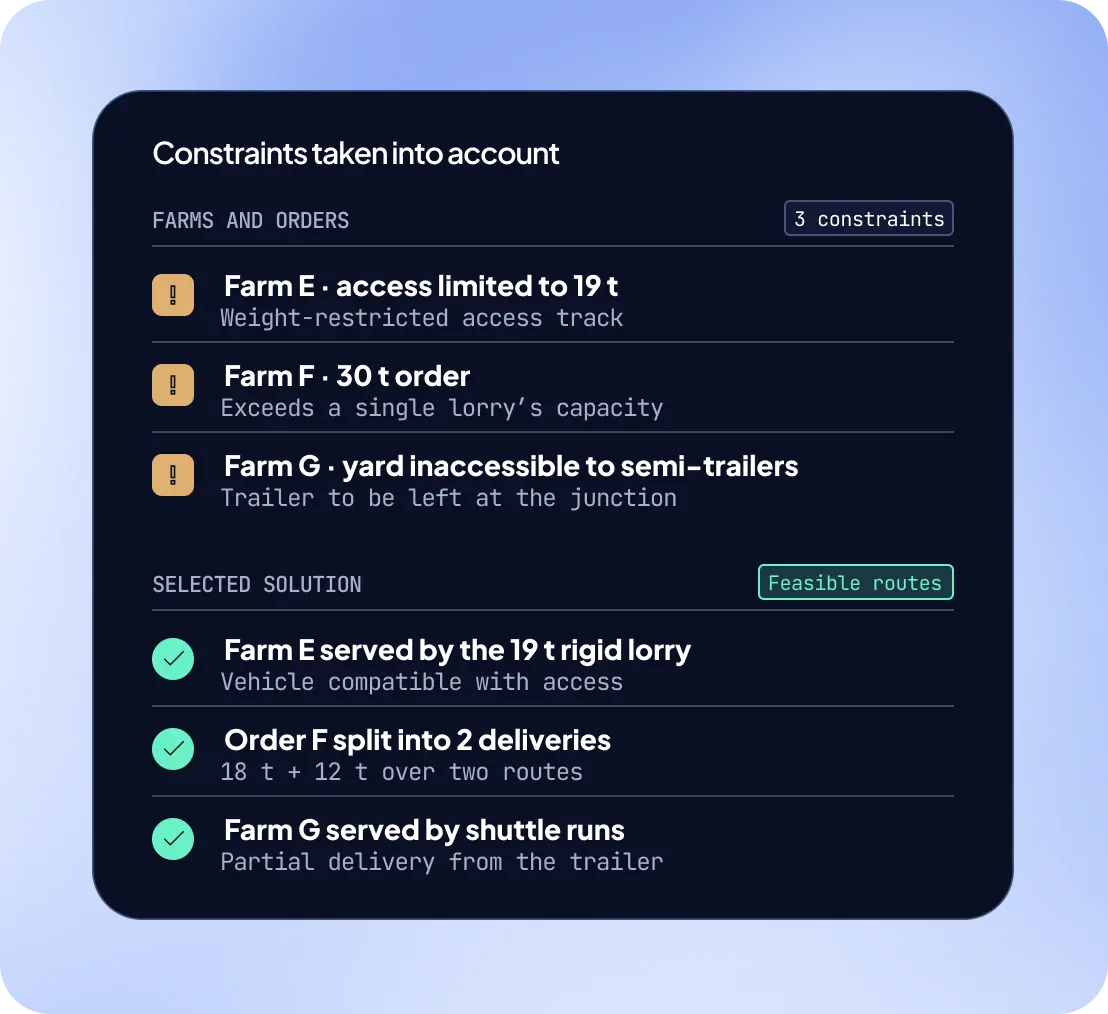
Access to a farm may be restricted by vehicle size or weight. When an order exceeds a lorry’s capacity, the engine can split it across several routes. For hard-to-reach sites, it can also organise partial deliveries from a trailer left nearby.
An API designed for your business software
Add feed delivery optimisation to your software in three steps.
Your delivery management software stays at the centre. API Optim allocates formulas across compartments, assigns each farm to the right lorry and sequences deliveries, then returns results ready to use in your software.
Step 1
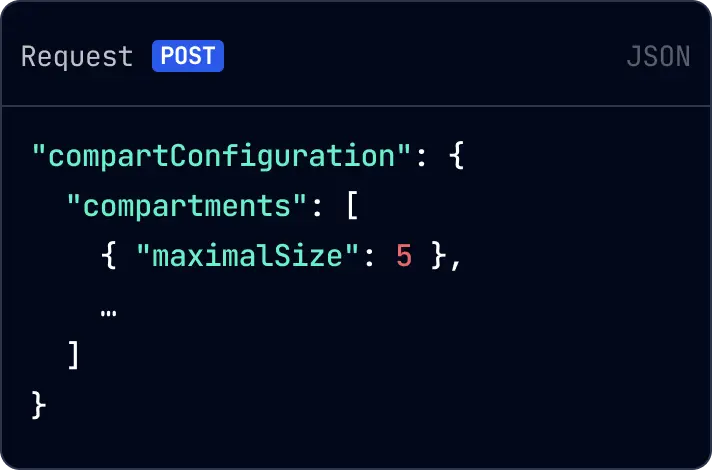
Describe your customers’ lorries and send the orders
Your software sends farmers’ orders (formula, tonnage, farm), the capacity of each compartment, the equipment of each vehicle and the equipment each silo requires. The compartCapacityAndAccessRule model is used to describe the compartments.
Step 2
Let the engine calculate loads and routes
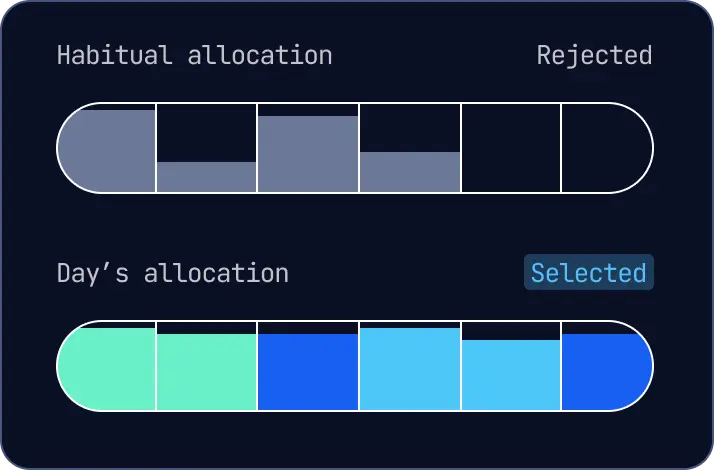
API Optim searches for an allocation compatible with the compartments, filling rules and the equipment required by each silo. It also optimises the assignment of farms to lorries and the delivery sequence.
Step 3
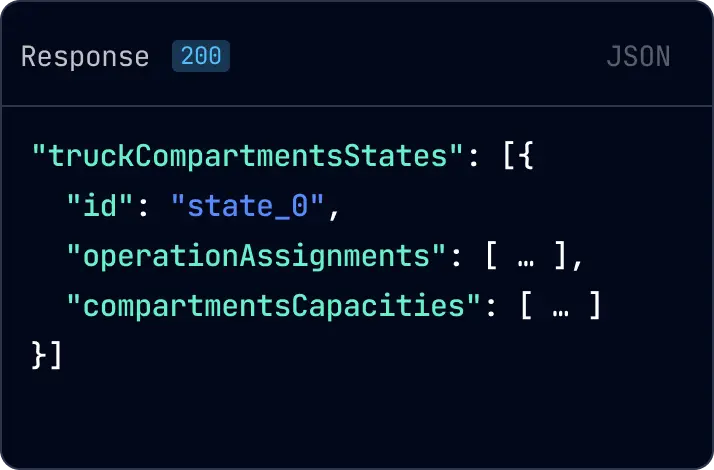
Retrieve routes and loading plans
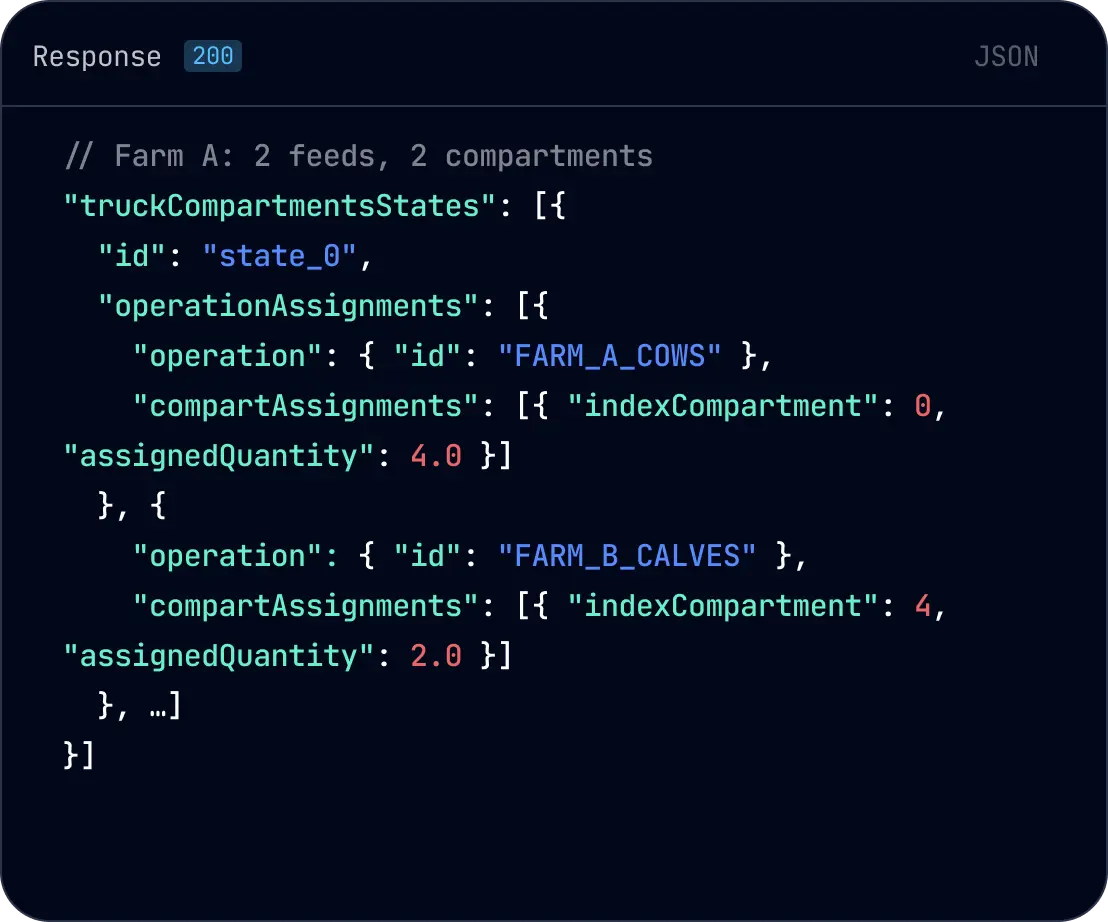
Your software receives the routes, the farm sequence and, for each order, the compartment to unload into each silo, via truckCompartmentsStates.
What your customers gain
More deliveries with the same fleet.
Every empty compartment and every failed delivery costs a trip. By matching loads to orders and sending the right lorry to the right farm, your customers get more out of their vehicles before adding new ones.

Better-filled bulk tankers
Formulas are allocated according to the day’s orders rather than a habitual allocation. Unused compartments and the need for an extra lorry are reduced.

Fewer failed deliveries
Equipment unsuited to the silo, a vehicle too heavy for the access track: these constraints are checked at calculation time, not when the driver arrives.

Fewer kilometres and less idle time
Routes take into account delivery time windows, unloading times and driving times. Unnecessary journeys and waiting times are reduced.
FAQ
Your questions about optimising animal feed deliveries.
How can animal feed delivery routes be optimised?
API Optim calculates routes taking into account farmers’ orders, lorry compartments, unloading equipment and farm access conditions. The engine optimises formula allocation and delivery sequence together.
Can several feed formulas be carried in the same lorry?
Yes, in separate compartments. A filling rule enforces a single formula per compartment, and incompatibility rules can prevent certain products from travelling together in the same vehicle.
Does the API take the unloading method (auger, blower) into account?
Yes. Your software declares the equipment of each vehicle and the equipment each farm requires: only equipped lorries can be assigned to the delivery. Unloading time can also vary with the equipment used.
Can a farm receive several feeds in a single visit?
Yes. Each feed is assigned to its own compartment, and the API response indicates the compartment used for each order. Your software therefore knows which compartment to unload into which silo.
Can bulk and bagged feed be delivered on the same route?
Yes, with a suitable vehicle: your software reserves certain compartments for bulk and a space for bags, big bags or pallets. Each product family can have its own rules, for example a different unloading time or delivery hours. Otherwise, API Optim splits bulk and bagged products between suitable vehicles.
How can bags be delivered to a farm without a forklift?
Your software declares that the farm requires an equipped vehicle, for example with a truck-mounted forklift or an electric pallet truck. API Optim then only assigns the delivery to a vehicle with that equipment.
How are hard-to-reach farms handled?
Your software can restrict access to a site by vehicle size, laden weight or equipment. For some sites, partial deliveries from a trailer left nearby can also be organised.
What happens if an order cannot be delivered?
The API reports unscheduled operations and gives their likely reasons, for example a missed time window or a site that is too far away. The planner knows immediately what to adjust.
Do my customers have to change software?
No. API Optim integrates with your software. Your software sends the data needed for the calculation and retrieves the results, and your customers keep working in the interface they know.
How long does it take to integrate API Optim into my software?
It depends on your technical environment, your data and the features to integrate. Our team can review your project and help you define the exchanges with the API.
Take the next step
Integrate the optimisation API for animal feed deliveries.
Could your customers’ lorries serve more farms with a different allocation of formulas? Let’s talk about it, starting from your software and your customers’ routes.
Industries related to animal feed

Flour milling
Bulk products delivered in compartmentalised tankers, often by blowing.


