

Flour milling · compartmentalised flour tankers
Add delivery optimisation to your software for bulk and bagged flour.
Help your customers make full use of their tankers’ capacity, even with compartments of different sizes. API Optim allocates flour orders across compartments to the nearest tonne and optimises routes according to loading and delivery constraints, directly from your software.
- Global optimisation of loads and routes
- One type of flour per compartment

Equal or unequal
Compartments described one by one,
with their actual capacity in tonnes.
1 flour
per compartment
reserved for one customer, or shared if the lorry has on-board weighing.
650 companies
already use our route optimisation engine,
across all industries.
The challenges of flour transport
Every tonne loaded weighs on the whole route.
Your customers organise bulk and bagged flour deliveries from their mill. With tonnages ordered, flour varieties, the capacity of compartmentalised tankers or bag compartments, and delivery sites’ reception slots, every load affects how routes are organised. A poor allocation can mean sending an extra lorry.

One bulk flour per compartment and per customer
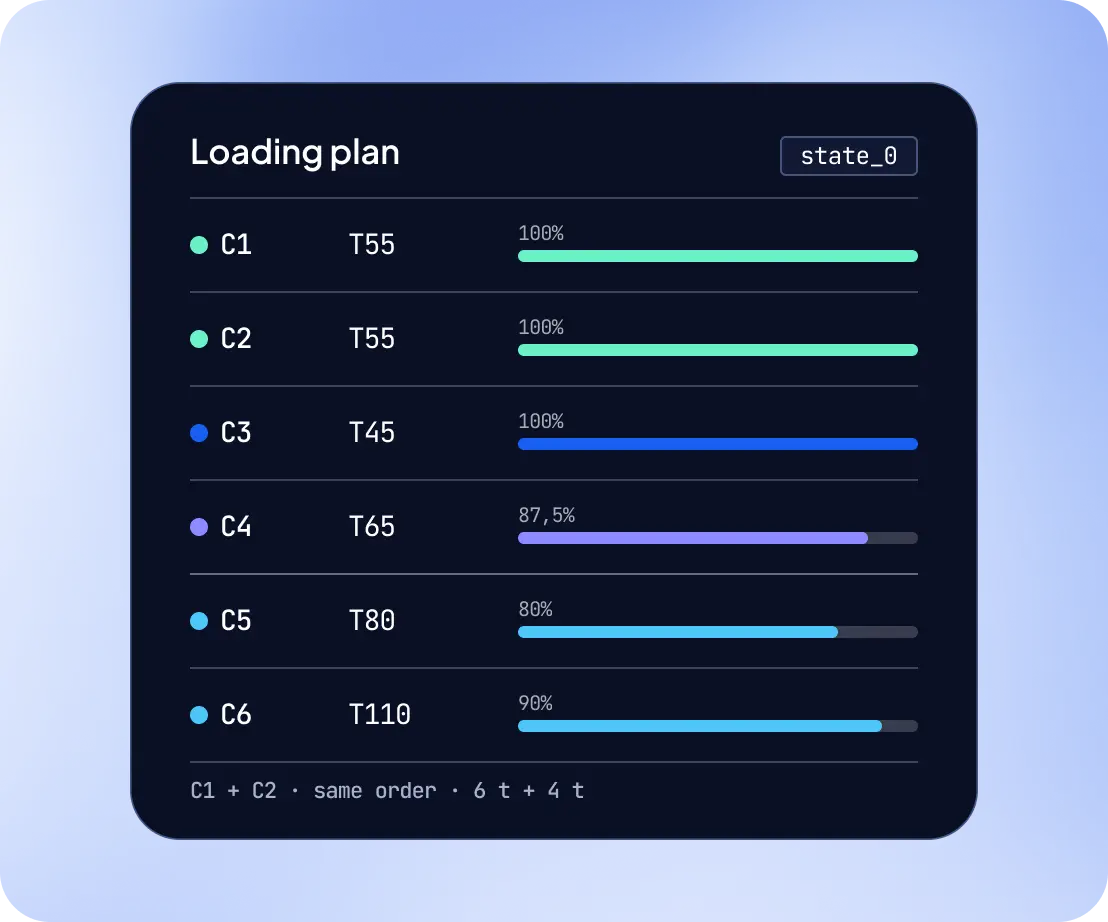
Each sealed compartment holds only one flour: T55, T65, organic flour… It is usually reserved for one customer, or shared if the lorry has on-board weighing.
Orders larger than a compartment
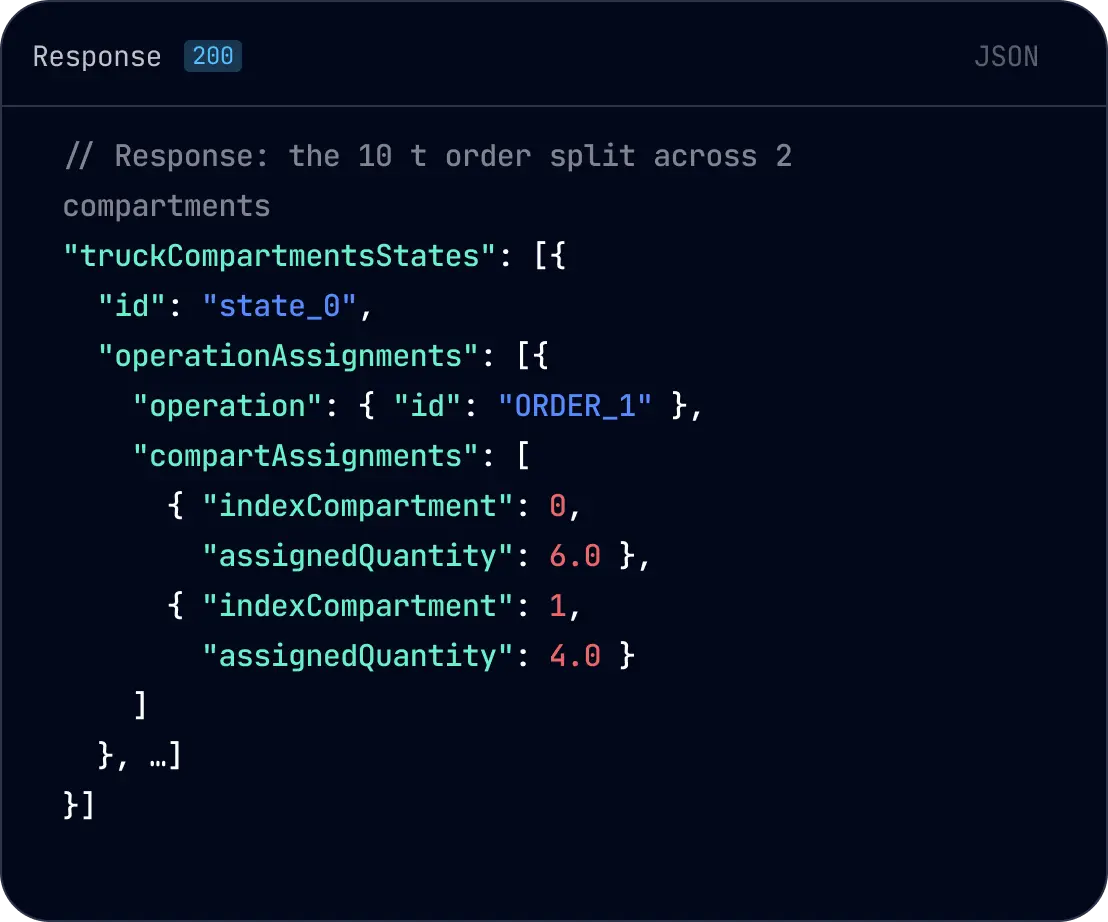
A 10 t order doesn’t fit in a 6 t compartment? Split across two compartments of the same tanker, it can be delivered without sending a second vehicle.

Delivery sites with different reception constraints
Industrial bakeries, biscuit factories, bakery and pastry sites: each site has its own reception slots, often early in the morning, its own access conditions (hoppers or pallets) and its own tonnages. The number of compartments often limits the number of sites delivered per route.
Why API Optim?
Flour tankers loaded precisely, order by order.
Does your software take into account the real configuration of your customers’ flour tankers? With API Optim, the capacity of each compartment, flour varieties and the mills’ distribution constraints all go into the same calculation.
| Criterion | Without compartment management | With API Optim |
|---|---|---|
| Tanker capacity | Only the lorry’s total capacity is taken into account. | Each compartment is taken into account with its actual capacity. |
| Fleet configuration | Several virtual vehicles may be needed to represent the different capacities. | Each tanker is described with all its compartments. |
| Flour varieties | Flour mixing is checked separately. | One flour per compartment, shared between customers or not depending on the lorry’s equipment. |
| Packaging (bags or bulk) | One vehicle type is often dedicated to each type of packaging. | The same lorry can carry bags and bulk, with each compartment accepting only the packaging intended for it. |
| Large orders | An order exceeding a compartment’s capacity may require another lorry. | An order can be split across several compartments. |
| Customers per route | The limit on customers per route is checked separately. | A maximum number of customers per route is set for each vehicle type. |
| Route optimisation | Load feasibility may be checked separately from route calculation. | Loads and routes are optimised at the same time. |
Illustrative comparison with management based on total vehicle capacity. Features vary between software products.
Tanker loading
Every load planned, from the mill to the last delivery site.
API Optim works out how to allocate flour orders across the compartments of your customers’ tankers while optimising the routes. Their teams get a usable result to prepare loads and organise deliveries.
Every order assigned to the right compartment
The engine takes into account the tonnages ordered and the capacity of each compartment, with one flour per compartment. When an order exceeds a compartment, it can split it across several compartments of the same tanker.
The information needed for each delivery
For each route, your software retrieves the orders assigned to the tanker, how they are split across the compartments and the delivery order. Blowing or delivery time can be calculated from the tonnage delivered, and access to each site can be restricted to vehicles fitted with a blower or suited to its size.
Better use of the tanker fleet
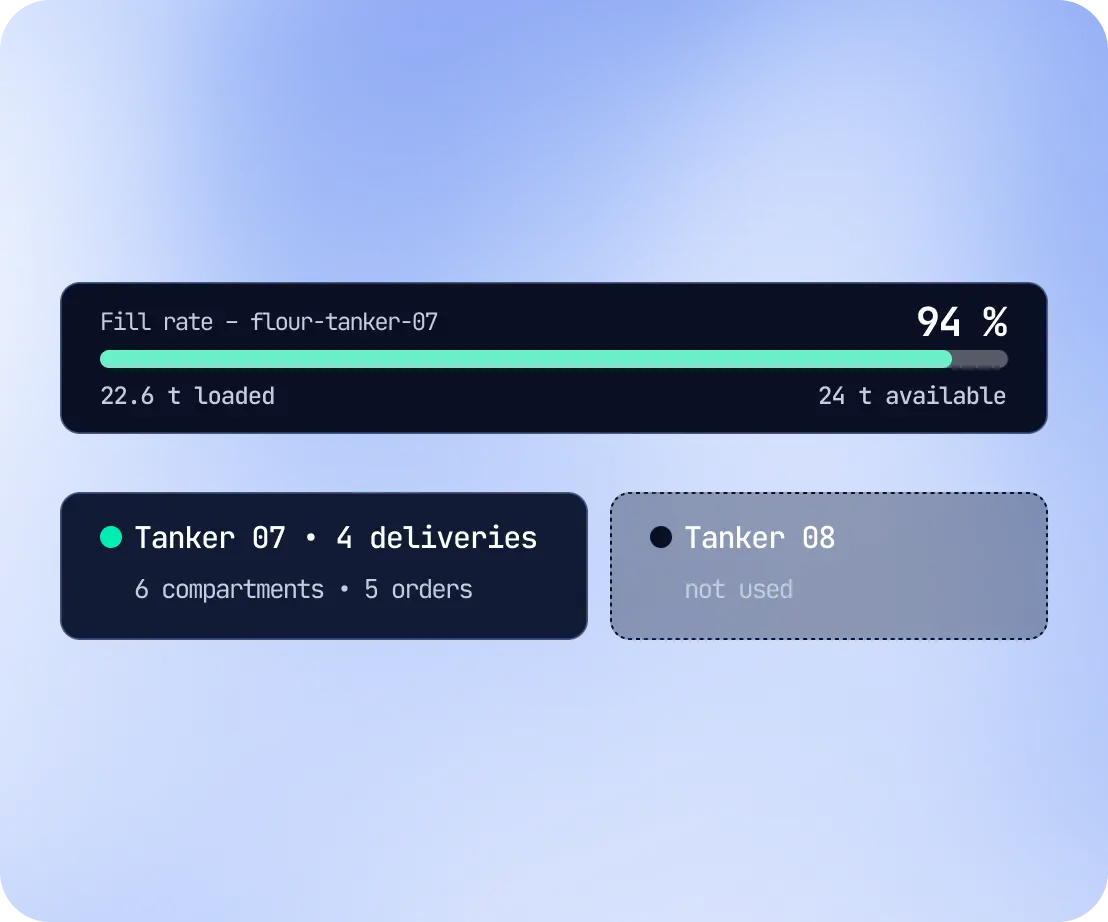
The engine groups more orders on the same vehicle where capacities and constraints allow. An order too heavy for a single tanker can be split across several routes. Your customers reduce extra routes and make better use of their existing tankers.
An API designed for your business software
Integrate tanker optimisation into your software in three steps.
Your flour mill management software stays at the centre. API Optim calculates loads and routes, then returns results ready to use in your software.
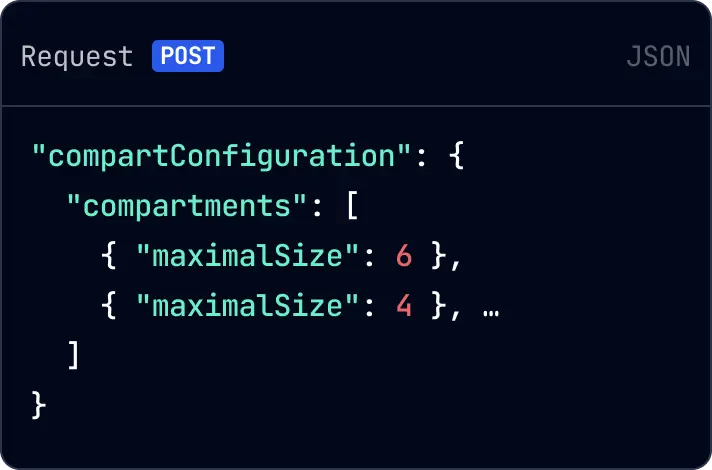
Step 1
Describe the tankers and send your customers’ orders
Your software sends the flour orders, tonnages to deliver, addresses and delivery sites’ time slots. It describes each tanker and its compartments by weight, using the model compartCapacityAndAccessRule.
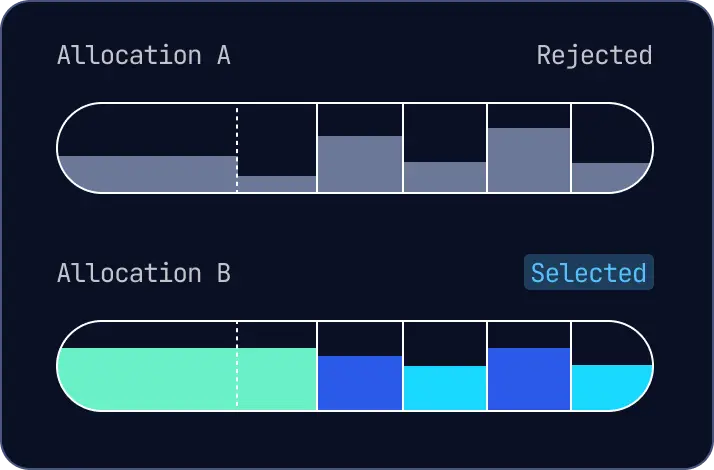
Step 2
Let the engine compare the possible allocations
API Optim looks for the best allocation of orders across compartments and builds optimised routes. The calculation respects capacities, the one-flour-per-compartment rule, reception slots and the number of customers per route.
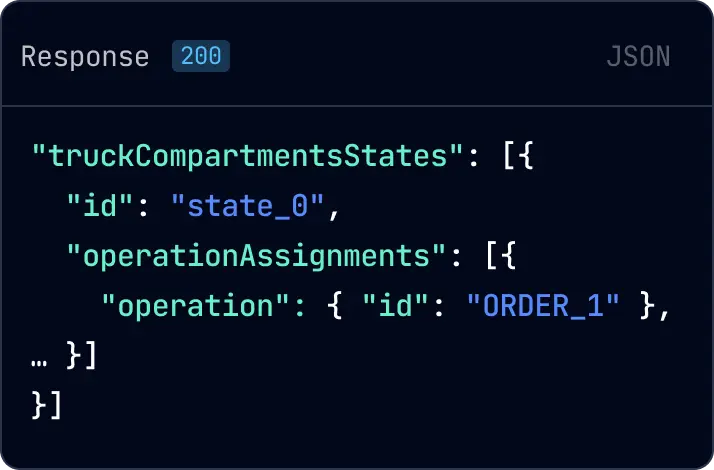
Step 3
Retrieve the routes and compartment states
Your software receives the routes, the assigned orders and how they are split across each compartment, with no need to rebuild the loading plan by hand. An urgent order comes in? The API can insert it into a route that is already planned.
What your customers gain
Lower distribution costs, without expanding the fleet.
Do your customers want to handle more orders without investing straight away in new tankers? By making better use of their vehicles’ compartments and limiting unnecessary journeys, they gain concrete levers to improve the profitability of their deliveries.

Fewer kilometres driven
Order assignment and delivery sequencing reduce unnecessary journeys, fuel consumption and the associated costs.

Better use of existing tankers
Tonnages are spread across the available compartments to limit unused capacity and avoid some extra routes.

Smoother loading at the mill
The number of available loading bays is taken into account to limit lorry waiting times when leaving the mill.
FAQ
Your questions about bulk flour delivery optimisation.
How can a flour mill’s delivery routes be optimised?
API Optim calculates routes taking into account flour orders, tanker capacities and delivery sites’ reception constraints. The engine looks for an allocation of loads and routes suited to your customers’ fleet.
How do you manage tankers with compartments of different sizes?
Your software describes each tanker with its compartments and their actual capacity, whether equal or different. API Optim uses this to allocate orders and build routes compatible with the vehicles. Capacities can be expressed by weight.
Can two customers share the same compartment?
Yes, if both orders are for the same flour and the lorry is fitted with on-board weighing. A filling rule, set for each vehicle type, reserves the compartment for a single order or opens it to several orders of the same product.
Can a flour order be split across several compartments of a tanker?
Yes. When an order exceeds a compartment’s capacity, the engine can assign it to several compartments of the same tanker. The response shows the quantity placed in each one.
How are delivery sites’ reception constraints respected?
Your software sends the addresses, tonnages ordered and reception slots. It can also restrict a site to vehicles fitted with a blower or limit access according to vehicle size. API Optim builds these constraints into the route calculation.
Can the number of sites delivered per route be limited?
Yes. Your software sets a maximum number of sites delivered per route for each vehicle type, for example four. The engine respects this limit in the calculation.
Can an urgent order be added to a route that is already planned?
Yes. The API can insert an order into an existing route by looking for the best position, without recalculating the whole plan.
Can API Optim integrate with my flour mill management software?
Yes. Your software continues to manage your customers’ orders and logistics operations. API Optim calculates loads and routes, then returns the results to your software.
How long does it take to integrate API Optim into my flour milling software?
It depends on your technical environment, the data available in your software and the features to integrate. Our team can review your project to define the steps needed.
Take the next step
Integrate the optimisation API for flour deliveries.
Could your customers’ flour tankers deliver more with a different allocation of orders? Let’s talk about it, starting from your software and your customers’ routes.
Industries related to flour milling

Animal feed
Bulk products delivered in compartmentalised tankers, often by blowing.

Fuel transport
Compartmentalised tankers and products that must never be mixed.


